


Ever wake up to blue skies, melting snow — and a pounding head?
In Calgary, Chinooks are practically a personality trait. These warm winds can send temperatures soaring in a matter of hours. For many people, that sudden shift feels energizing. For others, it can bring on headaches or even migraines.
So what’s going on?
Because, science!
What Is a Chinook, Exactly?
A Chinook is a warm, dry wind that flows down the eastern slopes of the Rocky Mountains. As air moves over the mountains and descends into Calgary, it compresses and warms rapidly.
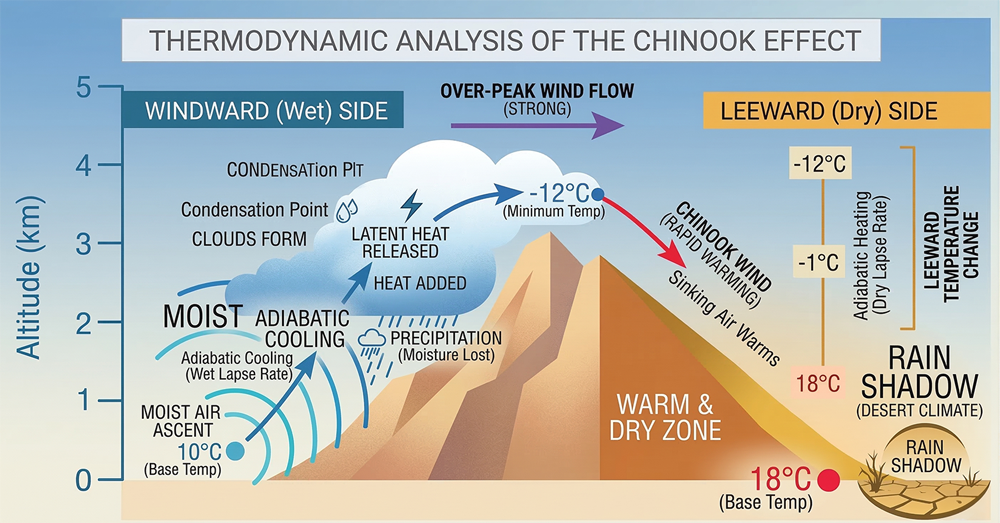
Where Do Chinook Winds Come From?
Chinooks arewhy temperatures can jump 10–20°C in just a few hours.
But it’s not just the temperature that changes.
Atmospheric pressure shifts quickly too.
And that’s where things get interesting.
How Air Pressure Affects Your Body
Even though we don’t feel air pressure directly, our bodies are constantly responding to it.
When atmospheric pressure drops quickly — as it often does before or during a Chinook — some people may experience:
- Headaches
- Facial pressure
- Migraine symptoms
- Sensitivity to light
- Brain fog
Not everyone is affected. But for those prone to migraines, rapid pressure changes can act as a trigger.
Researchers are still studying exactly why this happens, but there are a few leading ideas.
Why Warm Chinook Weather Can Lead to Headaches For Some
The Sinus Pressure Theory
Your sinuses are small, air-filled spaces inside your skull. Normally, the pressure inside your sinuses balances with the air outside.
When atmospheric pressure drops quickly, that balance can shift. If your sinuses don’t equalize right away, it may irritate surrounding tissue and nerves.
Result? Head pressure or discomfort.
The Migraine Trigger Theory
For people who experience migraines, the explanation may go deeper.
Some researchers believe pressure changes may:
- Influence blood vessel expansion or contraction
- Stimulate the trigeminal nerve (a major facial nerve involved in migraines)
- Affect brain signaling patterns in sensitive individuals
Migraine brains tend to be more reactive to environmental changes — including weather.
In other words, a Chinook might not “cause” a migraine, but it may help trigger one in someone already prone to them.
Science is still working to fully understand this connection — which makes it a fascinating example of how research evolves.
Why Some People Feel It — And Others Don’t
Not everyone gets a Chinook headache.
Sensitivity varies based on:
- Genetics
- History of migraines
- Sinus health
- Stress levels
- Sleep patterns
Two people can live in the same house during the same Chinook — and only one feels it.
That’s biology at work.
What Do People Commonly Try?
People who notice weather-related headaches often experiment with different strategies to manage symptoms.
Some report trying:
- Staying hydrated
- Resting in a dark, quiet space
- Caffeine (which can affect blood vessels and is included in some headache medications)
- Over-the-counter pain relievers
What works can vary widely from person to person. If headaches are frequent or severe, it’s always a good idea to speak with a healthcare professional. This is not medical advice!
Chinooks: A Local Example of Everyday Science
This is what makes Chinook headaches such a great example of everyday science.
A warm wind over the mountains connects:
- Geography
- Atmospheric physics
- Air pressure systems
- Human biology
- Neurology
All playing out in real time across Calgary.
Science isn’t just in labs or textbooks. It’s in the weather, in your body, and sometimes right between your eyes.
Still Curious?
Science starts with great questions.
Maybe you’re wondering why snow squeaks when it’s cold. Or why bubbles always seem to float upward. Or why some planets have rings.
Do you have a science question you’d like us to explore?
Leave it in the comments below!


Comments and Questions